

MBBS in Kyrgyzstan for Pakistani students is the cheapest popular MBBS route, with tuition often stated between about $2,900 and $5,000 a year. But the cheapest route is not automatically the safest choice. Three things decide whether Kyrgyzstan is right for you: the exact duration of your university’s programme, whether that university sits on the current PMDC list, and the language reality behind the “English-medium” label. This guide to MBBS in Kyrgyzstan for Pakistani students covers the universities, real fee ranges, recognition, safety facts and the return route.
Quick Verdict
- Degree: A medical degree (MD equivalent) whose length is university-specific: 5 years at some universities, 5 plus 1 year of internship at others, and 6 years at others.
- Fees: Tuition commonly stated from about $2,900 to $5,000 a year, with hostel about $450 to $900 a year and living about $150 to $250 a month. Figures conflict across guides, so confirm the current fee with the university.
- Entry: FSc Pre-Medical with at least 60% is the common minimum. No IELTS or TOEFL is generally required.
- MDCAT: PMDC has exempted the mandatory MDCAT pass for admission into foreign institutions, but whether that changes the older NRE eligibility bar is not stated anywhere. See the recognition section below.
- Recognition: Check your exact university on the current PMDC list before applying. A degree from a university that is not on the list is stated to be invalid in Pakistan, no matter how many years you studied.
- Language reality: Classes are marketed in English, but patient interaction during clinical years is often in Russian or Kyrgyz.
- Safety: Read the safety section below before deciding. It covers both the consultant claims and the May 2024 news reporting, with no current assessment available.
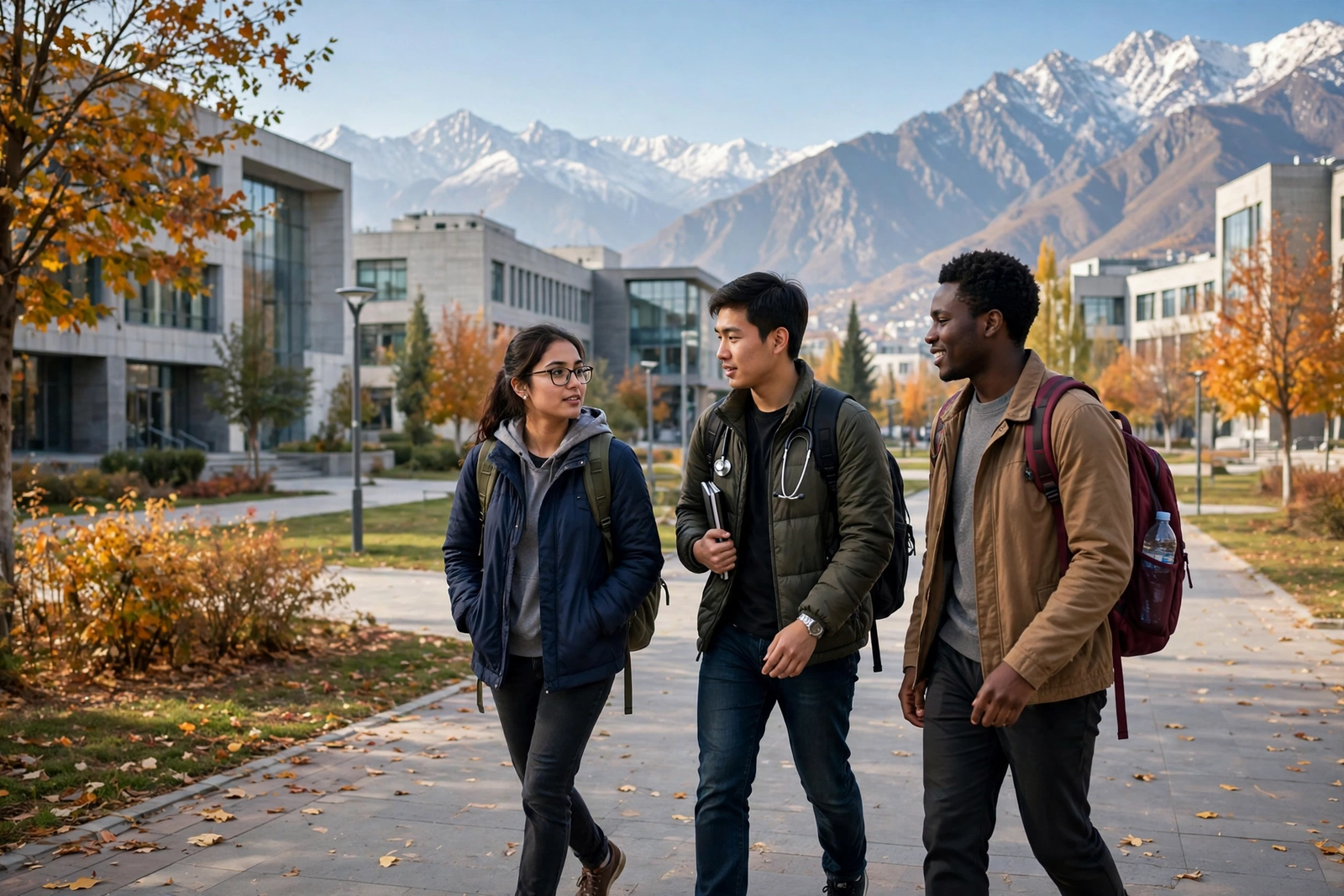
MBBS in Kyrgyzstan for Pakistani Students: Universities Commonly Chosen
The names below appear most often across guides. Fee and duration figures are source-stated and differ between guides, so treat them as planning ranges, not confirmed fee letters.
| University | City | Tuition as stated | Duration as stated |
|---|---|---|---|
| International Higher School of Medicine (IHSM) | Bishkek | About $3,500 a year in one table, $2,300 per semester in another | 5 years |
| International School of Medicine (ISM / IUK) | Bishkek | About $4,500 to $4,600 a year | 5 years |
| Kyrgyz State Medical Academy (KSMA) | Bishkek | About $4,500 a year | 6 years in one table |
| Jalal-Abad State University (JASU) | Jalal-Abad | About $4,000 to $4,200 a year | 6 years in one table |
| Osh State University | Osh | About $3,200 to $4,000 a year | 6 years in one table |
| Asian Medical Institute (ASMI) | Kant | About $3,400 to $3,800 a year | 6 years in one table |
| Kyrgyz Russian Slavic University (KRSU) | Bishkek | About $2,900 to $3,500 a year | 6 years in one table |
Two naming warnings matter. First, sources do not consistently distinguish Asian Medical Institute from Asian International University, and one page uses both names for the same cheapest-institution claim, so confirm the exact institution name on your admission letter. Second, some guides list several universities as “English/Kyrgyz” or “English/Turkish”, not English-only, which is a nuance most marketing pages bury. If you are comparing destinations, the general MBBS abroad for Pakistani students guide will help you judge Kyrgyzstan against other countries.
The PMDC List Warning: Read This Before You Pay
This is the most important section in this guide to MBBS in Kyrgyzstan for Pakistani students. Older consultant pages call Adam University, Royal Metropolitan University, Avicenna and others “PMDC-recognised”. A newer-list claim circulating in search results says only Ala-Too, IHSM, ISM/IUK, Asian University, Osh State, KSMA, KRSU and IMU are on the updated list, and that Royal Metropolitan, Adam, Avicenna and others were on the previous list but are not on the new one. The PMDC list PDF itself was opened during research, but its text did not render, so neither list could be verified from the official document itself.
When considering MBBS in Kyrgyzstan for Pakistani students, do not let any article, including this one, settle the question for you. The rule stated by the guides themselves is the safest one: if your university is not on the PMDC list, your degree will not be valid in Pakistan, no matter how many years you studied. Check the live PMDC list at the time you apply, confirm the exact university name and programme, and keep a dated copy of what you checked.
Real Fee Ranges, With Their Conflicts
No single audited budget exists, and even pages on the same website contradict each other, so the table below shows ranges, not one total.
| Cost item | Published range |
|---|---|
| Tuition, per year | About $2,900 to $5,000, by university |
| Hostel, per year | About $450 to $900, by university |
| Mess and food, per year | About $900 to $1,200 |
| Living (transport, personal, misc), per month | About $150 to $250 |
| Five-year total, one fee table | About $24,250 to $33,000 including hostel and mess |
| Five-year package claim, a sister page | About $11,000 to $20,000 including hostel and other charges |
The two five-year totals above cannot both be right, which is exactly why you should get the fee in writing from the university, including what the first year costs (often higher than later years), whether hostel and mess are included, and whether payment is per semester or per year. One guide also states a headline of about 14 lakh PKR a year including tuition, hostel and other expenses. Treat every figure here as a planning range.
Duration: 5, 5 Plus 1, or 6 Years
Duration is not a footnote in Kyrgyzstan, because PMDC’s stated rule is a programme of at least 5 years, with internships not counted in that duration. That makes the distinction material. Some universities run 5 academic years. Others run 5 years plus a 6 to 12 month internship in the sixth year. Others are listed at 6 years including a 1-year internship in a university-affiliated hospital. Before choosing, ask the university in writing: how many academic years, is the internship included or extra, and where is the internship done. The answer changes both your total cost and your recognition position.
Admission Steps and Entry Requirements
The common entry bar is FSc Pre-Medical with Biology, Physics and Chemistry at 60% or more. One page alone states 50% for scholarships, which conflicts with its own 60% PMDC pages, so use 60% as the planning figure. Age limits are stated differently across guides, roughly 17 to 25 at admission, with some pages allowing up to 30. No IELTS or TOEFL is generally required.
Documents usually asked for include your passport, SSC and FSc certificates and transcripts, photographs, medical clearance, police clearance and financial proof, though sources disagree on bank statements: one page says no bank statement is required for admission or visa, while others list bank statements as required. Application fees also conflict: one page states $150 with an e-visa route and no embassy visit, while another states a $300 application fee plus about an $85 visa fee with a 3 to 5 week process and an embassy appointment. Confirm the current route with the university before paying any fee.
The main intake starts in September, with applications generally opening in spring and closing in summer, and some guides also mention February or March intakes. The application route, in order, is: choose the university, apply online, submit documents, receive the admission letter, receive the visa document, pay the university fee as instructed, travel to Bishkek, register at the university, and start classes.
PMDC Recognition and the Return Route
PMDC Public Notice No. Exam-59/2026/350, dated 5 October 2026, records the Council’s decision of 14 September 2026 to exempt the mandatory MDCAT pass as a pre-requisite for Pakistani students seeking admission into foreign medical and dental institutions. That exemption covers the admission prerequisite only. Older guides still stating 50% MDCAT as mandatory are now out of date on that point. What no opened source states is whether the exemption also removes the older warning that students failing the old FSc and MDCAT bars would be ineligible for the National Registration Examination. Do not assume it does.
Students who want the background should also read the older MBBS abroad without MDCAT guide, which this update now supersedes on the MDCAT point for admission.
Dawn’s reporting of the same decision adds two qualifications: a student seeking transfer back to Pakistan midway would be required to clear the National Examination Board (NEB) assessment, and foreign graduates still have to appear in a registration exam to get a licence to practise. For the return route, PMDC’s current exam name is the National Registration Examination (NRE), with Step I theory and Step II clinical skills, and PMDC press material states that graduates who pass NRE Steps I and II qualify for a full licence.
Older guides call the same exam NLE, and terminology has changed over time, so use PMDC’s current terms at publication and confirm the current schedule on PMDC’s own website. The route stated by guides is: complete the internship, pass the licensing exam, take a provisional licence, complete a 1-year house job in a PMDC-approved hospital in Pakistan, then apply for full registration. For MBBS in Kyrgyzstan for Pakistani students, this return route deserves as much scrutiny as the fee.
Student Life: Halal Food, Hostels and Language
Kyrgyzstan is a Muslim-majority country, and halal food is widely available in Bishkek, Osh, Jalal-Abad and Kant, which is a genuine comfort factor for Pakistani families. Hostels are typically shared rooms, centrally heated, with separate hostels or floors for boys and girls at some institutes, and rooms fill fast, so late applicants may need higher-cost apartments.
As noted above, classroom teaching is marketed in English, but daily life runs in Kyrgyz and Russian, and patient interaction during clinical years is often in Russian, so learning basic Russian is a practical part of the degree, not an optional extra.
Safety: What the Sources Actually Say
Safety reporting on MBBS in Kyrgyzstan for Pakistani students splits into two sets, and both must be shown. Consultant pages describe a Muslim-majority country that is safe and comfortable for Pakistani students, with prayer, halal food and Islamic events. News reporting tells a different story for one period: VOA reported on 23 May 2024 that mob attacks on foreign students, including Pakistanis and Indians, hit universities and hostels in Bishkek on 17 and 18 May 2024, that nearly 4,000 Pakistani students left Bishkek and returned to Pakistan, and that students sheltered for hours before leaving.
No opened source gives a current safety assessment for Pakistani students after that period. Do not treat the 2024 events as the current situation, and do not treat consultant “safe” claims as verified fact either. Talk to current students at your chosen university before deciding.
Frequently Asked Questions
Is an MBBS degree from Kyrgyzstan valid in Pakistan?
Yes, but only if you graduate from a university and programme on the current PMDC list and pass the NRE licensing exam. A degree from a university that is not on the list is stated to be invalid in Pakistan regardless of years studied.
Is MDCAT required for MBBS in Kyrgyzstan for Pakistani students now?
For admission into foreign institutions, PMDC has exempted the mandatory MDCAT pass under its notice dated 5 October 2026. Whether that exemption changes the older NRE eligibility bar is not stated in any opened source, so verify it with PMDC before relying on it.
Which is the cheapest university in Kyrgyzstan for Pakistani students?
Cheapest claims differ by source and by whether the figure is tuition only, tuition plus hostel, or per semester, so no single cheapest university can be named honestly from the guides. Asian Medical Institute and the similarly named Asian International University appear most often in cheapest claims, but confirm the exact institution and the exact fee in writing.
Is the degree 5 years or 6 years?
It depends on the university. Some run 5 academic years, some run 5 years plus an internship year, and some are listed at 6 years. Get the breakdown in writing, because PMDC’s duration rule makes the distinction material.
Kyrgyzstan rewards students who verify before they pay: a university on the current PMDC list, a written fee and duration breakdown, and a clear-eyed view of the language and safety picture. The expensive mistake is choosing on a headline fee alone, or trusting an old list that may no longer be current. Oscar Overseas Education can help you check a university against the current PMDC list before you apply, so the degree you earn is one Pakistan will recognise.